
3.8 KiB
Steinberg SDK integration (Phase 106)
The VST3 host uses Steinberg's pinned generated C ABI in the C99 core. Optional SDK examples now also build against the full, separately supplied official C++ SDK and run Steinberg's validator. This adds an independent interoperability check without adding a C++ runtime or network dependency to libxtc.
Working integration
- Linux
.vst3bundles resolve toContents/<architecture>-linux/<bundle-stem>.so. Direct.sopaths still work. The original chosen path remains the saved identity reference. This supports conventional bundles, not arbitrary renamed modules or Windows DLLs. - VST3 processing receives sample rate, absolute sample position, tempo and
musical position (
samples / rate * BPM / 60). Position follows the existing effect/instrument_atAPIs, including seek. Tempo is the prepared plugin spec's milli-BPM value; reprepare when it changes. Processing is marked playing because this API represents active rendering, including offline rendering. Loop, recording, wall-clock, time signature and continuous-time flags are not asserted: the current plugin API does not carry that information. Positions aboveINT64_MAXreject before processing, matching VST3's signed sample clock. - Original SDK-built examples expose a mono half-gain effect and a mono, 16-channel sine instrument. The instrument handles note-on/off at their exact block offsets; the host translates all-notes-off to held-note releases.
- The C render example demonstrates the actual xtc plugin facade and WAV writer, including no-clobber output, without requiring JACK or a GUI.
See the example instructions for SDK versions, build commands, validation and ASIO diagnostics.
Screenshots
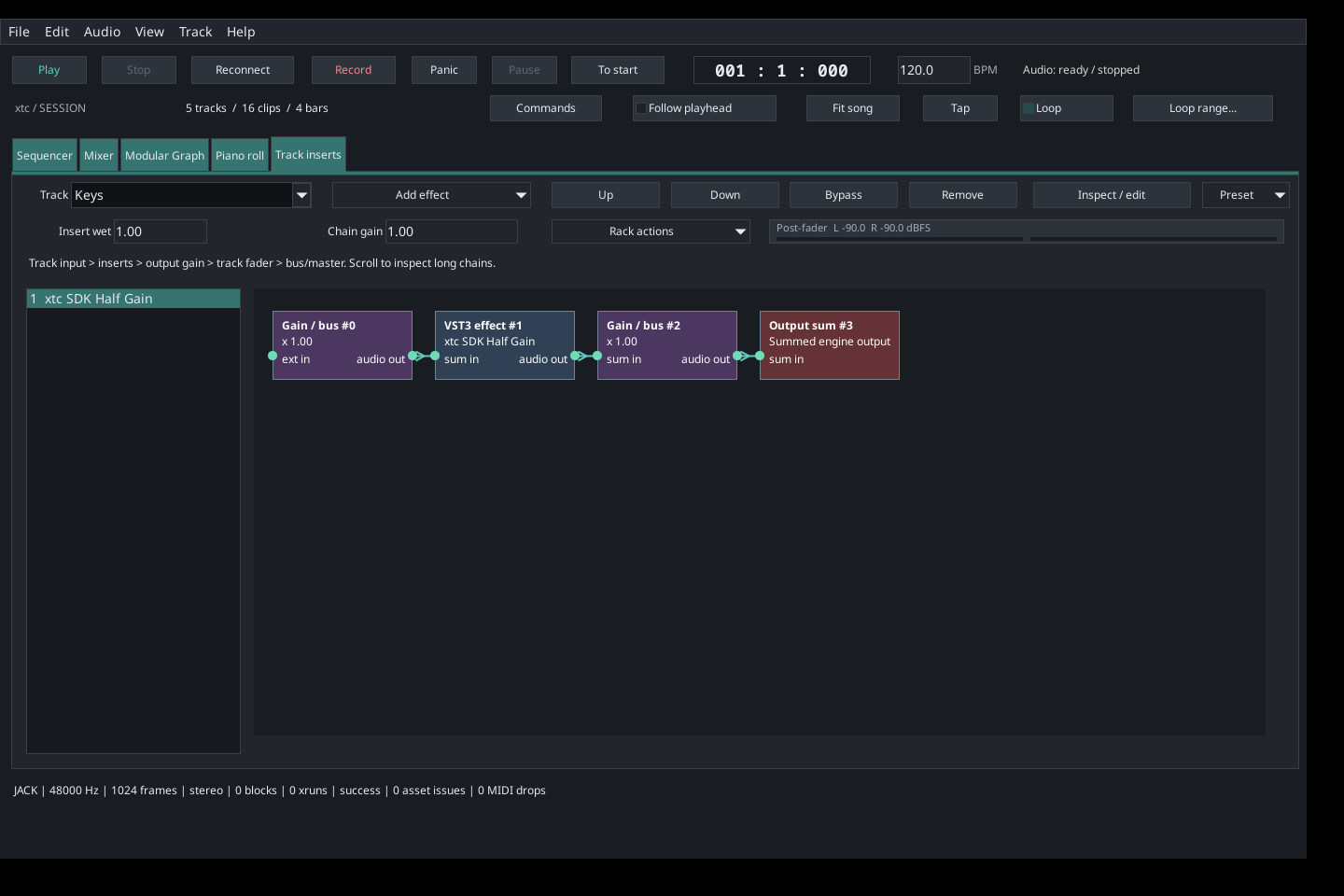
The actual SDK-built effect in xtc's host. See its identity dialog, the SDK Sine instrument chooser and capture commands. These examples have no custom editor; the screenshots show xtc's host interface with playback stopped. They do not demonstrate ASIO hardware operation.


ASIO and VST2 scope
ASIO is native driver I/O, separate from VST plugin hosting. The optional Windows diagnostic enumerates drivers and inspects an explicitly selected driver's channels, sample types, current sample rate, buffer bounds and reported latency. It does not create/start audio buffers and is not an xtc ASIO backend. The current xtc engine/backend still targets Linux/POSIX and JACK/PipeWire. Windows portability, a C API platform bridge and native-driver qualification are remaining Phase 106 work, not simulated by Linux tests.
VST2 support retains the existing original minimal ABI declarations. VST3's SDK does not include the discontinued VST2 SDK. No VST2 SDK or user plugin is copied, fetched or licensed by these build targets.
Remaining work
The application VST3 adapter still accepts one mono input (or no audio input for instruments), one mono output, float32 and zero reported latency. Its two mono instances are not a native stereo plugin instance. It uses plugin defaults; controller parameters, opaque-state persistence and custom editor windows remain unimplemented in xtc. The SDK examples include an edit-controller class for standard SDK-host compatibility; xtc does not instantiate it yet. The examples have no editable parameters or opaque state, so they do not prove those paths. No VST extension support or general third-party compatibility is inferred from the validator passing these examples.
The complete acceptance checklist is in Phase 106.