
8.7 KiB
xtc screenshots
The complete gallery was refreshed after Phases 100–105 on 2026-11-06, including MIDI preferences/import, the sample editor, creative workflows and real installed VST3 insert chains. These are actual rendered application windows and menus on a 1440 × 960 virtual X11 screen, without mockups, compositing or image edits.
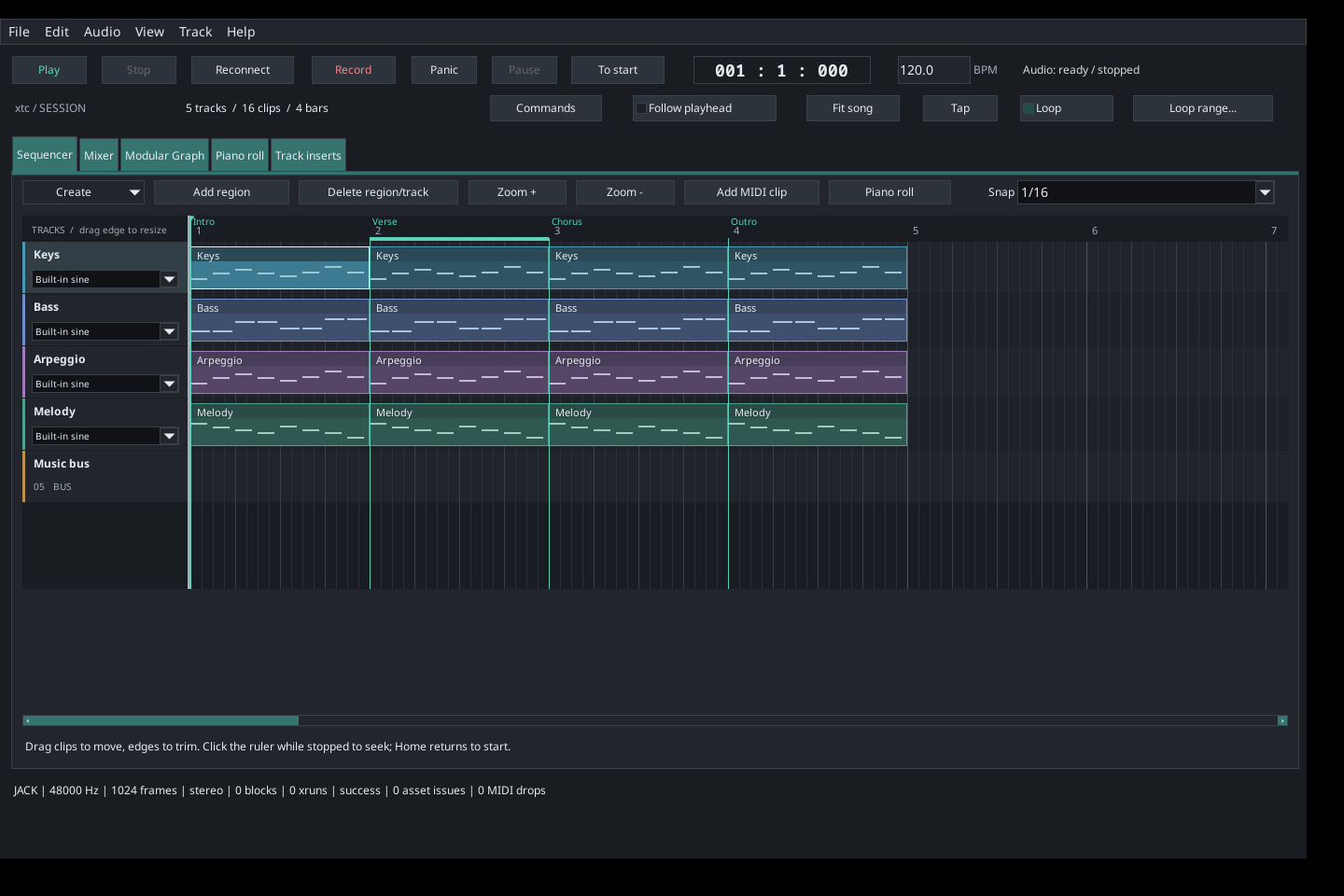
The temporary demonstration project starts from
examples/projects/modern-session.xtc, adding Intro/Verse/Chorus/Outro markers,
a routed music bus and gain automation. Editing results use the real control
APIs and GUI history/preparation paths. Original projects, media and user
configuration are not overwritten. Black margins are the virtual desktop;
floating views show the actual detached windows together.
MIDI devices, defaults and file exchange (Phases 100–105)
- MIDI source/destination preferences and channel defaults
- Device setup and MIDI defaults help
- File menu with MIDI import and selected-clip export
- An exported clip reimported into a new arrangement
- The imported notes and velocities in the piano roll


These captures use real file export/import and the real preferences schema. No hardware device names or connected devices are fabricated; blank port defaults mean no automatic connection. Actual device choices depend on host JACK/PipeWire exposure. Configuration paths are disabled in captures to preserve user settings. See MIDI workflows and limits.
Reproduce these five captures with
XTC_CAPTURE_MIDI_ONLY=1 make BUILD_DIR=build/audio-editor screenshots.
Creative workflows (Phases 90–99)
Four real captures show the current transport Tap button, insert meters and creative controls; the rest of the gallery also reflects the current UI.
- Dub Echo template in the insert graph
- Rack actions: bulk edits, comparison and chain clipboard
- Chord strumming controls
- Strummed chord notes in the piano roll


Reproduce only these captures with
XTC_CAPTURE_CREATIVE_ONLY=1 make BUILD_DIR=build/audio-editor screenshots.
The rack shows the actual template and idle meter; no live peak readings are
fabricated. See creative workflow limits.
Compact workspace and installed VST3 effects (Phases 80–89)
- Compact sequencer workspace
- Create dropdown over the sequencer
- ZamEQ2 → ZamAutoSat → ZamDelay on the Keys track
- Verified VST3 identity and adapter capabilities
- Parallel wet/dry branches in the actual insert graph


The three VST3 effects are installed on this host under /usr/lib/vst3, loaded
through the real host and prepared in the track's chain. These are host graph
and identity views; native plugin editor windows are not available. The
identity view explicitly reports default configuration and absent parameter
controls. Long graphs scroll horizontally. See
TRACK_INSERTS.md for precise compatibility limits.
New arrangement and composition workflows
| Phase | Feature | Captures |
|---|---|---|
| 58 | Persistent named arrangement markers | Ruler, marker editor |
| 59 | Section navigation and looping | Current section loop |
| 60 | Ripple time insertion/removal | Controls, inserted gap |
| 61 | Complete track duplication | Independent layered track |
| 62 | Nondestructive MIDI splitting | Split clip |
| 63 | MIDI clip consolidation | Consolidated clip |
| 64 | Seeded MIDI humanization | Timing, velocity and seed |
| 65 | Chord construction | Intervals, generated notes |
| 66 | Offline arpeggio generation | Step, gate and direction, written pattern |
| 67 | Audio peak normalization | Target dBFS, normalized clip |
| 68 | Portable media collection | New destination folder |


Collection is also executed by the capture tool into its temporary directory; the screenshot shows its destination prompt, not a file browser or progress UI. See COMPOSITION_WORKFLOWS.md for precise behavior, limits and commands. The screenshots illustrate implemented workflows; they do not establish feature parity with other DAWs.
Audio source editor (Phases 69–79)
- Frame selection, waveform, statistics and processing controls
- Detected source attacks and clip slicing controls


These captures show the actual modal editor with the repository pluck WAV. Processing is staged locally; Save full copy and relink applies it to the project. See AUDIO_EDITOR.md for limits and frame/tick rounding.
Refreshed application views
All pre-existing images below were recaptured. Mixer playback meters come from
real JACK callbacks. The minimum-size capture uses a 1220 × 720 main window;
the scrolled view adds twelve tracks. Audio views import the repository's
original-pluck.wav and apply clip gain/fades. The older descriptor/control views use repository test
fixtures. The track-insert views below use real installed host VST3 binaries. Internal instrument menus and delay/reverb
editors show the real available devices and controls. The command palette uses
the current application action list.


Detach panels from the View menu; close a floating window or use its Dock button to return it to the main window.
Reproduce the gallery
From the repository root, run:
make BUILD_DIR=build/next-daw screenshots
This optional documentation target requires the existing FLTK/JACK build
prerequisites, a running JACK server, Xvfb (xvfb-run), ImageMagick (import) and
xdotool. It builds the repository plugin fixtures, runs
the capture tool, and replaces the gallery
PNGs. All demonstration edits and collection outputs use an automatically removed
temporary directory; no preferences are saved. It neither installs dependencies
nor starts/reconfigures the audio server.
Set XTC_CAPTURE_SAMPLE_ONLY=1 for the capture tool (or the make target) to write
only the two sample-editor images while retaining the existing gallery.
To reproduce the host captures where those Zam bundles are installed:
XTC_CAPTURE_HOST_VST3=1 xvfb-run -a -s '-screen 0 1440x960x24' \
  ./build/audio-editor/capture_screenshots "$PWD/screenshots"
Run make BUILD_DIR=build/audio-editor screenshots first to build the tool and
refresh the full fixture/demo gallery. All captures use temporary projects and
preserve user settings and original media.