
12 KiB
Just a Sample v1.3
This page acts as a tutorial for Just a Sample, and also documents some hidden features and use-cases.
JAS is shorthand for Just a Sample.
Other Versions
Contents
Plugin Interface
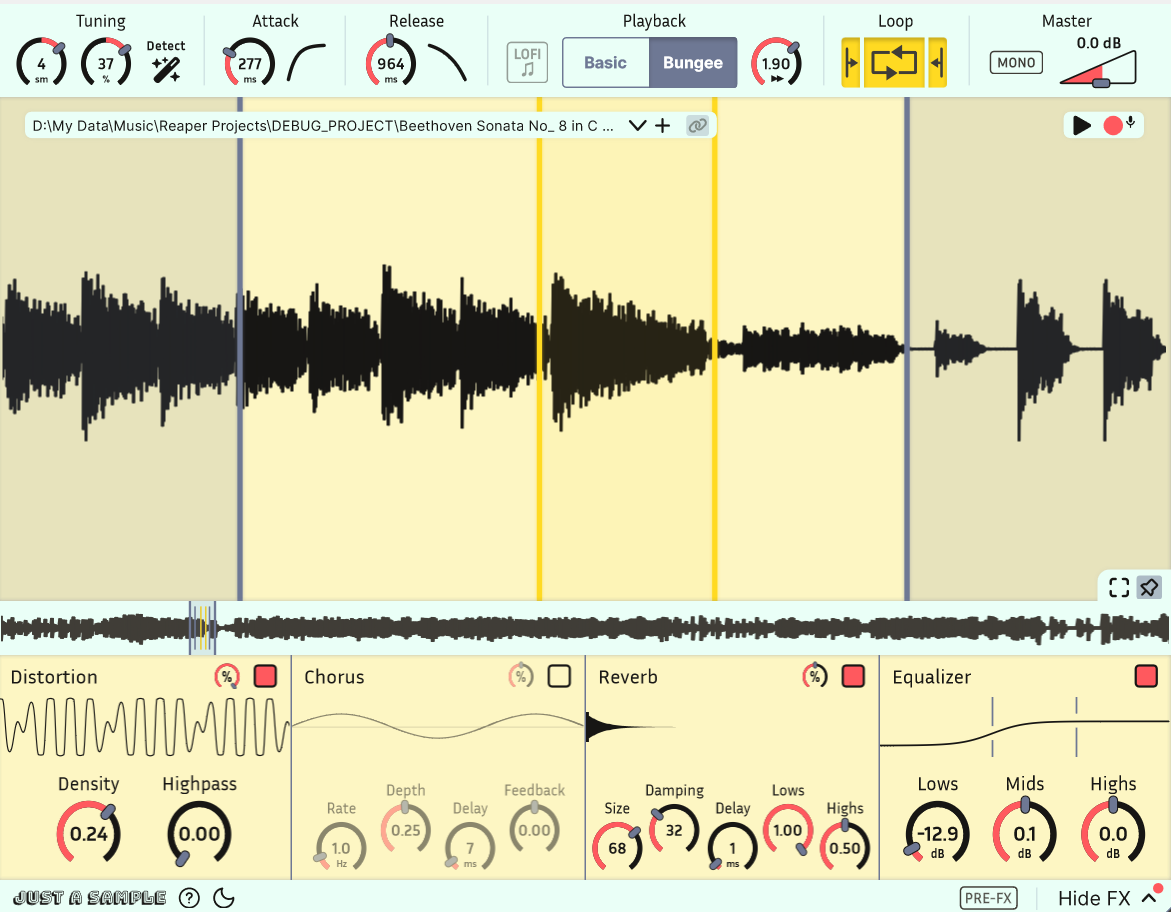
Playback Controls

After loading a sound into Just a Sample, the header is the first place to find key playback controls.
Drag vertically over controls to change their values smoothly. You can also double-click on text to edit with precision.
Most controls can be automated smoothly.
-
Tune the pitch of your sound with the semitone control (-18 to +18) and finetune with the cent control (-100 to +100).
-
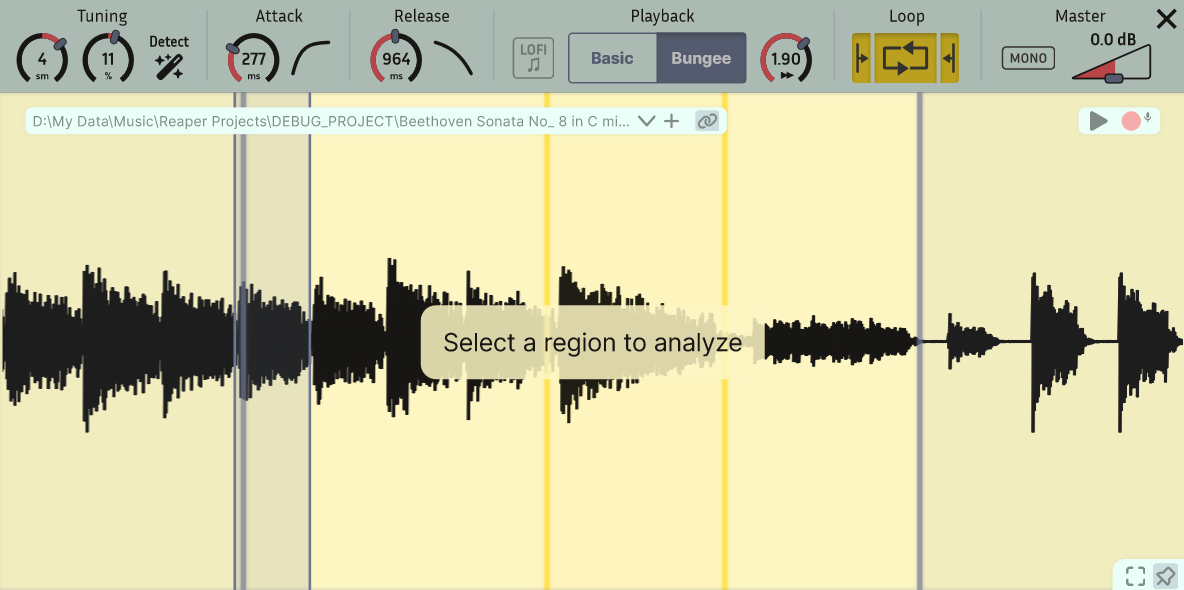
EXPERIMENTAL: This control opens a dialog to select a region of your sample. JAS will analyze the pitch of the selected region and automatically set the semitone and cent controls, such that the center A plays at 440hz. This works best on simple sound sources.
-
The attack envelope controls the volume of your instrument when a note is first activated. You have fine control over the attack length and shape. You should use a short attack time for quicker sounds and a longer attack time for more drawn out sounds. The default value is 1ms, but most sounds will use >20ms for a more natural feel.
-
The release envelope controls the volume of your instrument when a note is released. The envelope will trigger automatically when your note nears the end of the sample.
-
In Basic playback, Lo-Fi disables anti-aliasing, resulting in a grittier, retro sound.
-
JAS supports two modes of playback.
- In Basic playback, sounds are resampled to different pitches by changing their speed. This maintains the quality of the sound but makes it difficult to deal with notes far from center.
- In Bungee playback, sounds are resampled with a complex algorithm to preserve time. This takes very high CPU, but expands the range of functional notes and gives more control over timing. Distortion becomes more noticeable 2-3 octaves from center. Note that resampling to a higher pitch takes more CPU.
-
In Bungee playback, change playback speed freely (0.01x to 5x) without affecting pitch.
-
Looping wraps the end of a sound back to its start, allowing you to hold out a note indefinitely. When looping is enabled, JAS allows for separate control of a sample start and sample end portion. Playback occurs as follows.
- Begin playback at sample start.
- At loop end, wrap back around to loop start.
- When the note is released, jump to the start of the sample end portion, and fully continue playback until sample end.
JAS uses a power-preserving crossfade to handle these transitions. The crossfade length can be controlled via plugin parameter Crossfade Samples.
-
Mono mixes the plugin output to mono, averaging the channels. This is reflected visually in the waveform views.
-
The gain control scales the plugin's output volume.
Editor and Navigator
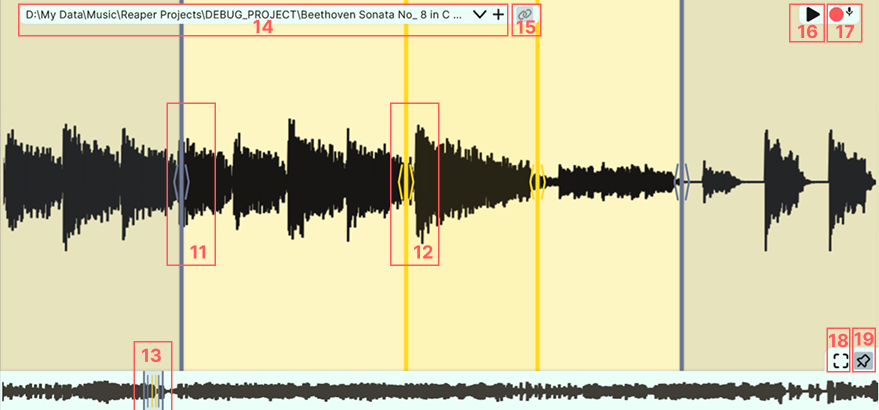
Through the editor and navigator views (top and bottom waveform), JAS enables modern, powerful navigation. Enjoy beautiful, fast rendering. These views also display active voices.
The editor allows you to visualize your waveform and adjust the sample playback bounds. Use your mousewheel or trackpad to intuitively zoom in/out and move the editor view around the loaded sample. Modifier keys adjust the response.
-
Freely move sample bounds.
-
Freely move loop bounds.
JAS enables sample-level precision. Seamlessly zoom in to the level of individual samples.
At a high zoom level, JAS will display channels separately. For visual clarity, only a single channel will have full opacity. This is purely visual, and you can select which channel is focused by clicking on the waveform.
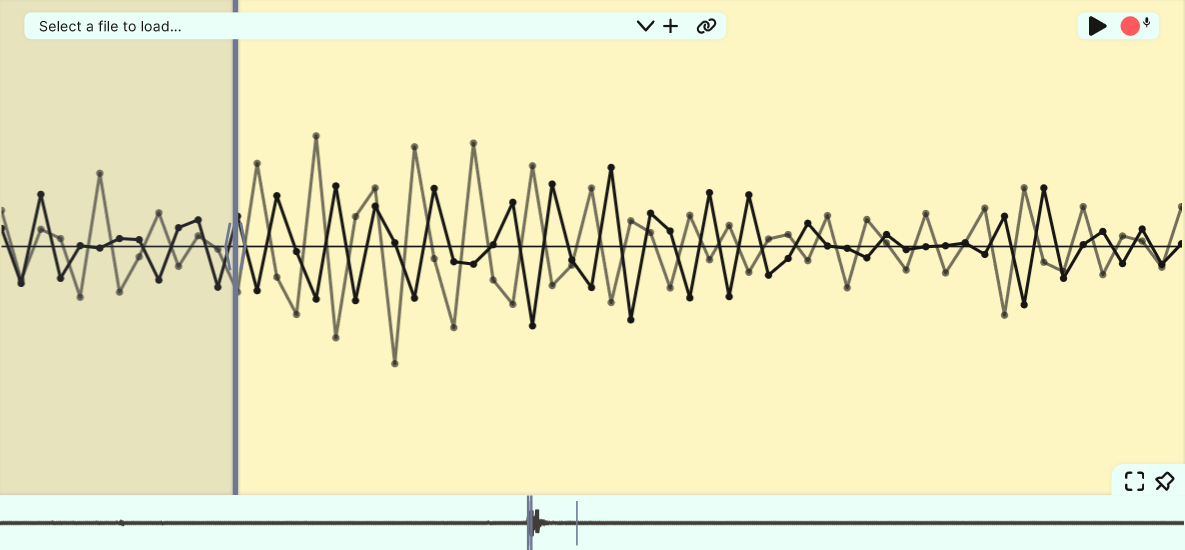
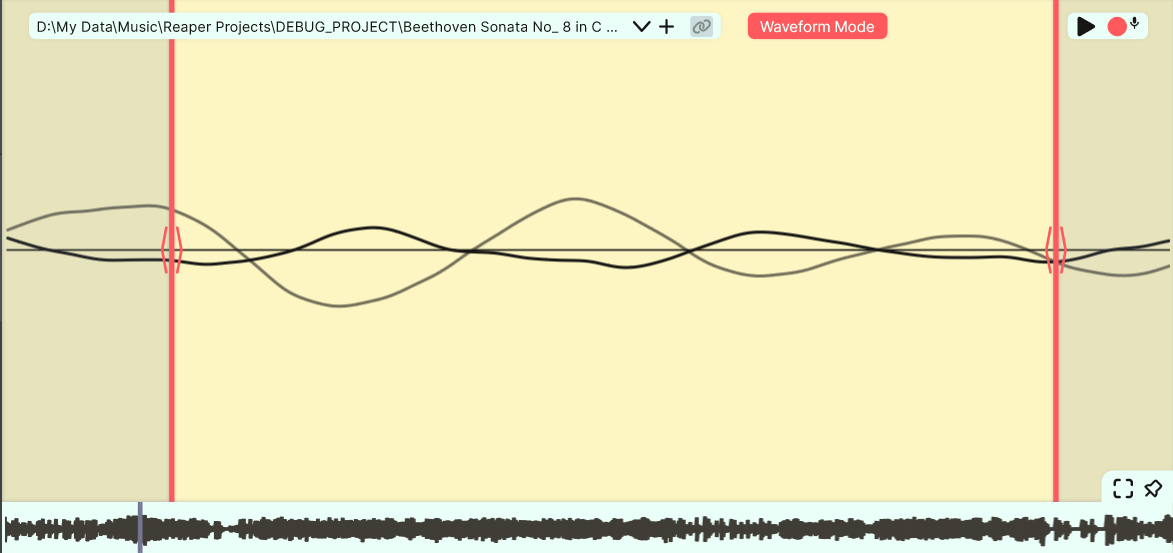
JAS includes a special feature when the sample bounds go below a small threshold. Waveform Mode loops your sample bounds like a wavetable synth. Combined with the effects chain, this feature turns JAS into a unique and surprisinly versatile synthesizer. It also comes with separate tuning parameters. I have lots of fun with this, exploring the sound of different waveforms.
Note that the Waveform Mode label also functions as a toggle, in case you need to disable it.
-
JAS pairs the editor with the navigator, which acts as a "scrollbar" of sorts for your waveform. Use your mouse to quickly move around and resize the view. The navigator also reacts to scroll gestures like the editor. Double-click to reset the view.
-
The file selector stores a history of loaded files and lets you load a sample directly from your file explorer.
-
For convenience, JAS automatically stores small samples in plugin state. That means no more dealing with missing files! Your sampler presets will work forever, even if you lose track of your samples. You may disable this functionality with the file link toggle. This feature is also disabled for larger files.
-
The play button lets you listen to your work without leaving the plugin. It doubles as a halt button whenever voices are active.
-
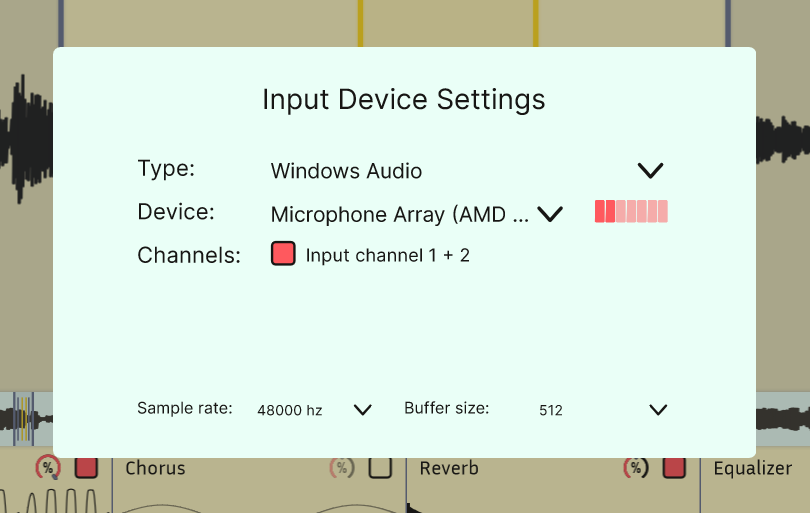
For convenience, JAS allows direct recording into the plugin. Configure your audio inputs with the little mic icon.
-
Fit the editor view to your sample bounds.
-
Pin the sample bounds to the editor view. This control fixes the sample bounds to their current locations on screen, maintaining their place as you move or zoom the bounds. This is convenient when you want to easily explore a large sample without moving your sample bounds manually.
Effects

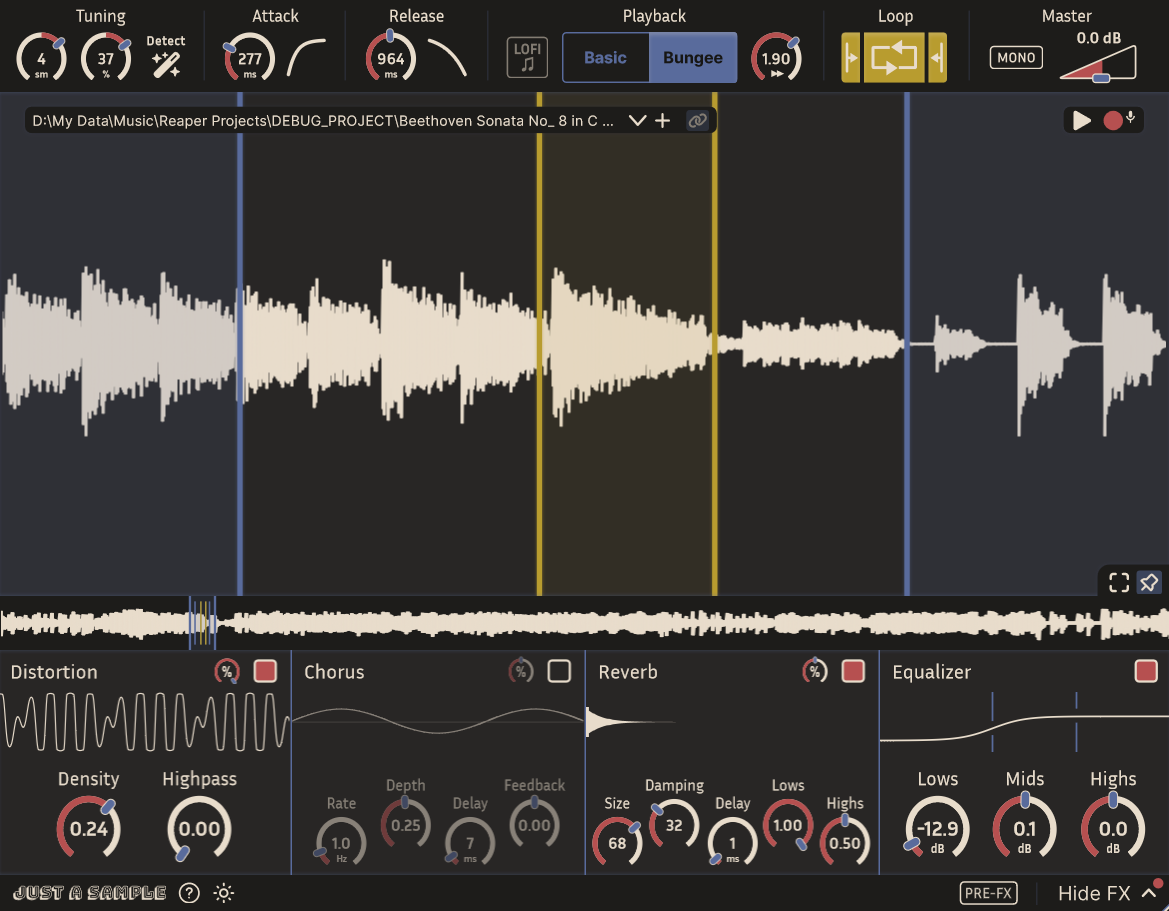
The effects chain lets you fine-tune your sound without leaving the plugin interface. JAS provides four effect modules, which can be freely reordered.
-
Mix between the unprocessed and processed sound (input and output respectively).
-
Enable an effect before you start using it, or quickly disable it.
-
Distortion can add subtle warmth, heavy grit, or completely warp your sound. Density controls the intensity of the changes. Highpass removes lower tones from your sound.
-
Chorus simulates the sound of multiple voices playing in unison, creating a thicker, more spacious sound. Rate controls the speed of movement. Depth sets the intensity of pitch variation. Delay determines the base delay time. Feedback feeds a portion of the processed signal back into the input. Higher feedback levels produce unexpected sounds.
-
Reverb adds space and echo, simulating different environments. Control the virtual size and damping of your space. Delay the effects of the reverb to create an echo effect. Control the lows and highs of the reflections to simulate different surfaces.
-
The equalizer allows you to modify the tone of your sound by adjusting different frequency bands. You can boost or cut the lows, mids, and highs of your sound to shape the overall character—whether you're removing muddiness, adding presence, or brightening the top end. Change the cutoffs by moving the vertical bars with your mouse.
Footer

The footer contains some additional, non-essential plugin controls.
-
Show or hide the FX chain. JAS hides the effect chain by default for better visual clarity.
-
Pre-FX applies the FX chain before the attack and release envelopes. This can be useful in mimicking the effect of "bouncing" your effects.
-
The help text is context aware, providing basic info wherever your mouse is located. This includes the values of controls.
-
Dark mode can reduce eye strain.
-
More help opens this page :)
-
The logo shows the plugin's version number in the help text and opens the main GitHub page.
Other Features
Some useful features are not visualized in the UI.
-
JAS has some extra parameters. Every DAW supports accessing parameters a bit differently, either by turning off the plugin GUI or through a parameter automation menu.
-
Wide Tuning is a continuous tuning control that spans -48 to +48 semitones (8 octaves). This is useful for automating pitch changes.
-
Pitch Wheel Range controls the radius of pitch wheel modulation in semitones. The default is 1 semitone.
-
Disable Velocity makes it so that all notes are played at the same volume.
-
Voice Count allows you to change the maximum number of voices (notes playing at once). This is set to 256 by default but can be lowered to handle CPU limitations.
-
MIDI Range Start and MIDI Range End controls the interval of notes that JAS accepts. This is useful if you want to insert multiple plugin instances on the same track to handle different intervals.
-
MIDI Root Note sets the note that plays the sample at its original pitch. The default is MIDI note 69 (A4).
-
Follow MIDI Pitch can be disabled to always play the sample at a fixed pitch.
-
Play Until End can be enabled to ignore note-off events, always playing the sample until end.
-
A4 Frequency allows you to change the reference pitch for tuning. The default is 440hz. This is only relevant for detect pitch and Waveform Mode.
-
Crossfade Samples controls the amount of crossfade applied when looping.
-
Octave Speed Factor stretches out the usable range of Bungee mode by changing the playback speed. This is somewhat like a hybrid control between Basic and Bungee.
-
-
JAS has MTS-ESP support for microtonal tuning.
-
Drag the bottom right corner to freely resize the plugin.
-
JAS has special support for Reaper!
-
The UI Update parameter triggers Reaper to save plugin state on non-parameter changes, allowing you to undo/redo every interaction.
-
On Windows, load a file in JAS using ReaScript:
reaper.GetSetMediaTrackInfo_String(track, "P_EXT:FILE", filePath, true)This feature is not inherently limited to Windows, but I've had a hard time getting the SDK working on other platforms.
-
Tips and Tricks
-
In Bungee mode, lower playback speed to a value less than 0.1x, and add some effects. This can create amazing pads!
-
Zoom in to Waveform Mode and pin your sample bounds to easily explore your waveform. Move your bounds around with a touchpad as you play to see how the sound morphs.
-
Set Voice Count to 1 to play JAS like a mono synth.
-
Turn on Pre-FX and enable reverb. Then increase size and decrease damping to maximize the effects of the reverb. Notice how Pre-FX smoothly cuts off the reverb when you release notes.
-
Try to have fun! Your tools are only as good as your creative potential.