- C++ 85.3%
- CMake 10.8%
- Makefile 3.4%
- C 0.5%
| Source | ||
| .gitignore | ||
| CMakeLists.txt | ||
| LICENSE | ||
| Makefile | ||
| README.md | ||
| shot.png | ||


Mindball
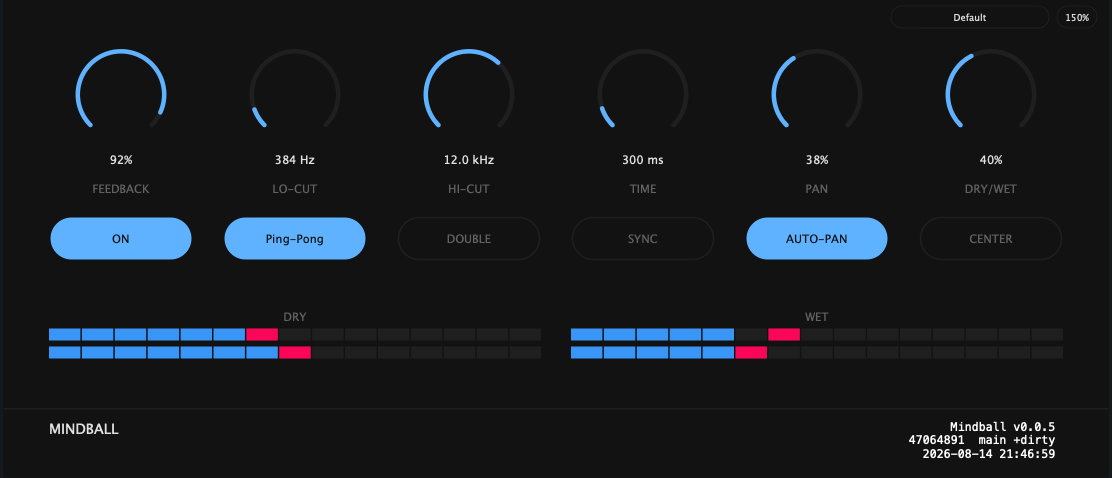
A minimalist stereo delay plugin with a no-frills UI. Feedback echoes, ping-pong and inverting modes, tempo-synced delay time, and an auto-panner - all wrapped in a clean, resizable interface with 20 factory presets.
Built with JUCE 8.0.9 and CMake, available as a VST3, Audio Unit and standalone app.
Screenshot
Features
- Stereo delay engine with independent left/right delay lines (up to 16 seconds)
- Smooth delay-time changes - a two-head crossfade avoids the pitch-bend artifacts of a gliding read head
- Feedback loop filtering - separate low-cut and high-cut filters on the repeats
- Four modes: Normal, Invert, Ping-Pong, SuperPong
- Tempo sync - 12 note divisions (1/16 to 8 bars), tempo read from the host
- Double, Center and Auto-Pan options, with a syncable panning LFO
- Per-channel level meters with peak hold
- 20 factory presets and a UI scale control (50%–300%)
- No external runtime dependencies - no GTK, no libcurl
Controls
Knobs
| Control | Range | Default | Description |
|---|---|---|---|
| FEEDBACK | 0 – 95% | 35% | Amount of the delayed signal fed back |
| LO-CUT | 20 – 4000 Hz | 100 Hz | High-pass filter on the delay repeats |
| HI-CUT | 500 – 18000 Hz | 12 kHz | Low-pass filter on the delay repeats |
| TIME | 10 – 3000 ms | 300 ms | Delay time (or note division when synced) |
| PAN | 0 – 100% | 100% | Auto-pan depth (when AUTO-PAN is on) |
| DRY/WET | 0 – 100% | 40% | Mix between the dry and delayed signal |
Toggles
| Toggle | Description |
|---|---|
| ON | Bypass the effect (inverted indicator) |
| MODE | Cycles Normal → Invert → Ping-Pong → SuperPong |
| DOUBLE | Adds a second tap at twice the delay time |
| SYNC | Syncs TIME to the host tempo instead of milliseconds |
| AUTO-PAN | Applies a stereo LFO to the wet signal |
| CENTER | Collapses ping-pong/superpong output to the center |
Meters
DRY and WET level meters show both channels with peak hold. A red segment marks the current peak.
Top bar
- Preset menu - pick one of the 20 factory presets; the active preset is ticked
- UI scale menu - resize the interface from 50% to 300%
Presets
Default, Slapback, Analog Echo, Tape Echo, Dub Delay, Ping-Pong, Wide Ping-Pong, SuperPong, Sync 1/16, Sync 1/8, Sync 1/4, Sync 1/2, Sync 3/4, Invert, Hall Echo, Whale Song, Filtered Space, Auto-Pan Delay, Centered Pong, Clean Echo.
The currently loaded preset is detected from the live parameter values, so if you tweak a knob the preset name updates to the closest match.
Building
Prerequisites
- CMake 3.22 or newer
- A C++20 compiler
- JUCE 8.0.9 is fetched automatically from GitHub - you only need a network
connection (or
git) on the first configure. To build against a local checkout instead, pass-DJUCE_ROOT=/path/to/juce.
Quick start (any platform)
A Makefile is included as a convenience wrapper around the CMake commands
below - it doesn't add any extra build logic, it just calls cmake for you:
make          # configure and build all formats (AU VST3 Standalone)
make install  # build, then copy the plugins to the standard locations
make clean    # remove the build directory
Pass CMake options straight through with CMAKE_ARGS (e.g.
make CMAKE_ARGS=-DJUCE_ROOT=/path/to/juce), or override the defaults with
make BUILD_TYPE=Debug or make FORMATS="VST3 LV2". If you prefer to drive
CMake directly, the underlying commands are:
cmake -B build -DCMAKE_BUILD_TYPE=Release -DMINDBALL_FORMATS="AU VST3 Standalone"
cmake --build build -j --target Mindball_VST3 Mindball_AU Mindball_Standalone
macOS
cmake -B build -DCMAKE_BUILD_TYPE=Release
cmake --build build --target Mindball_VST3 Mindball_AU Mindball_Standalone
Requires the Xcode command line tools. Built plugins are copied to
~/Library/Audio/Plug-Ins/VST3 and ~/Library/Audio/Plug-Ins/Components.
Linux
cmake -B build -DCMAKE_BUILD_TYPE=Release
cmake --build build --target Mindball_VST3 Mindball_Standalone
Building requires the development packages for X11, FreeType, FontConfig and ALSA. Install them with your distro's package manager:
Debian / Ubuntu:
sudo apt-get install pkg-config libx11-dev libfreetype-dev libfontconfig-dev libasound2-dev
Fedora:
sudo dnf install pkgconf-pkg-config libX11-devel freetype-devel fontconfig-devel alsa-lib-devel
Arch Linux / Artix:
sudo pacman -S pkgconf libx11 freetype fontconfig alsa-lib
Mindball deliberately does not require the GTK/webkit2gtk or libcurl development
packages. libcurl support is disabled in juce_core, and the GTK-dependent
juce_gui_extra module is not linked.
Build formats
The default formats are AU VST3 Standalone. Override with the MINDBALL_FORMATS
cache variable, e.g.:
cmake -B build -DMINDBALL_FORMATS="VST3 LV2"
Project layout
CMakeLists.txt                  Build configuration (JUCE, formats, Linux checks)
Source/
  PluginProcessor.cpp/.h        Audio processing and the parameter tree
  PluginEditor.cpp/.h           UI: knobs, toggles, meters, presets, scale
  DelayEngine.h                 Stereo delay engine (filters, modes, crossfades)
  DelayLine.h                   Circular buffer delay line
  BuildInfo.h.in                Template for generated build info header
License
See the LICENSE file, as well as the source files. This project is licensed under an MIT license, but uses the JUCE framework, which is subject to its own licensing terms, hence there are no binary files for this project - you need to compile it yourself, which pulls in JUCE.